
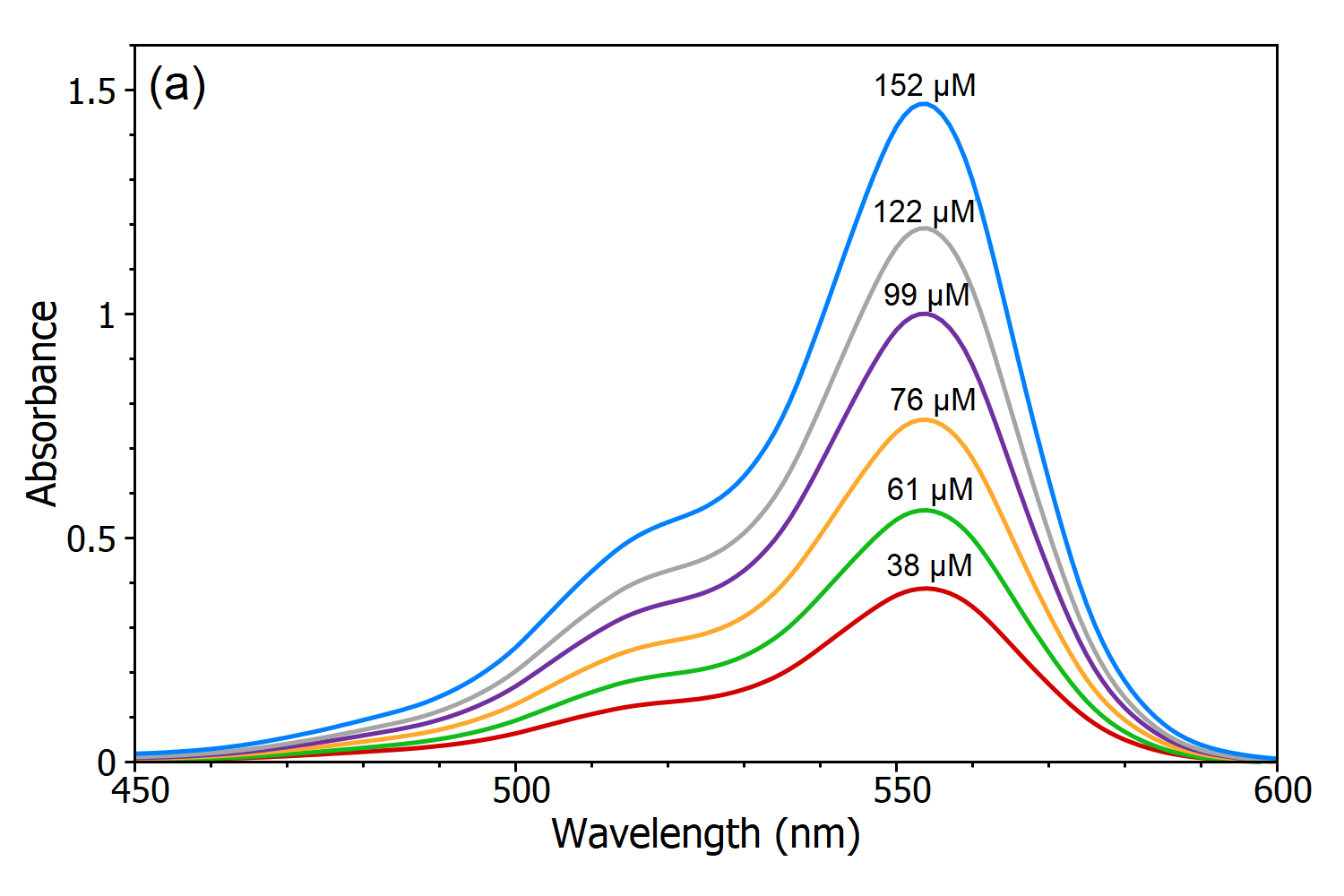
In Figure 1 the iron thiocyanate ion absorbance at 470 nm is plotted as a. Using the absorbance values obtained for a series of volumetric dilutions made from a stock solution of known Allura Red concentration a Beers law plot of absorbance versus concentration will be constructed.
Beer Lambert Law


Prime Scientific Theory And Practice Of Spectrophotometric Measurements

The Pharmaceutics And Compounding Laboratory
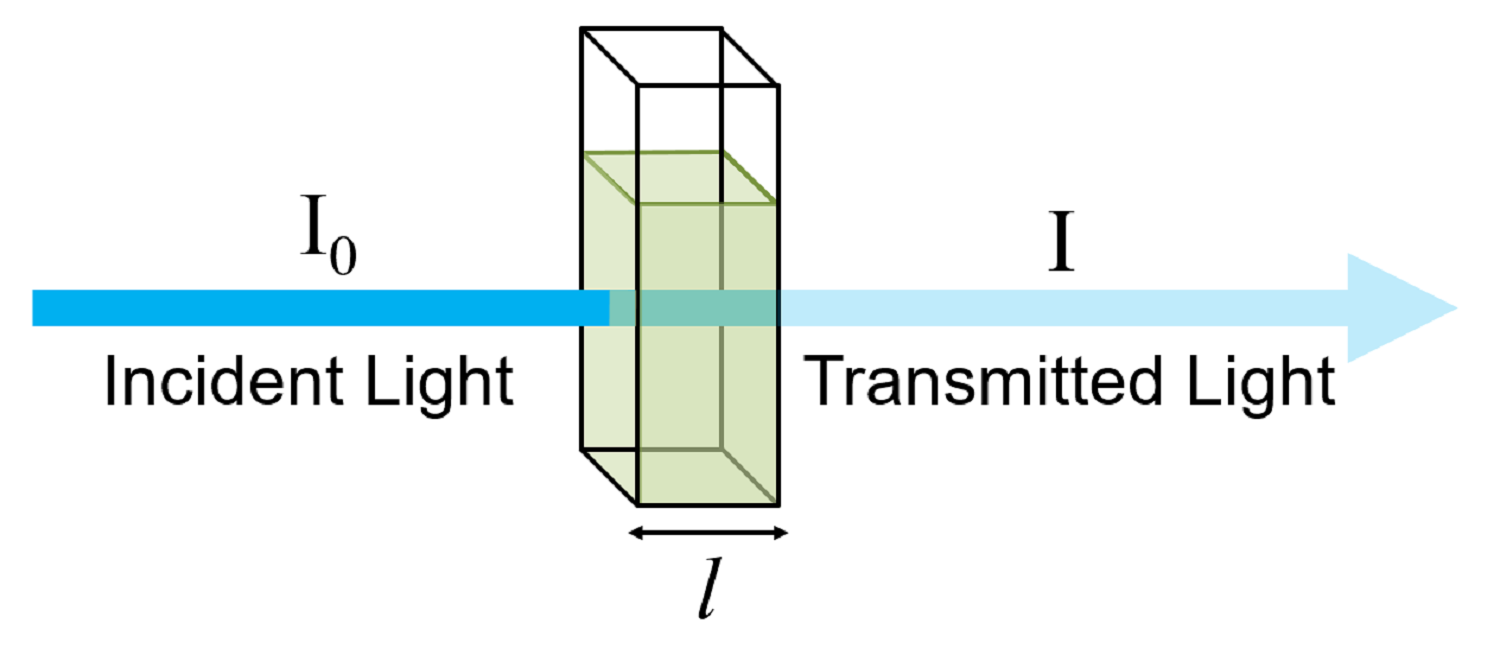
This law is concerned with the thickness of the medium.
Unit of absorbance in beer's law. 1 Each absorbing molecule chromophore is independent of the other -. Absorbance A To determine the concentration of FDC Red No. Understand the Beer-Lambert law for absorbance A ɛ x l x c.
The absorbance of each solution will be measured and recorded. Alternatively for samples which scatter light absorbance may be defined as the negative logarithm of one minus absorptance as measured on a uniform sample. Lets assume a condition in which the light passes through the object without any absorbance it means 100 light will.
A sample in a 1cm cuvette gives an absorbance reading of 0558. ε has units of L mol 1 cm 1. Concentration of known solutions.
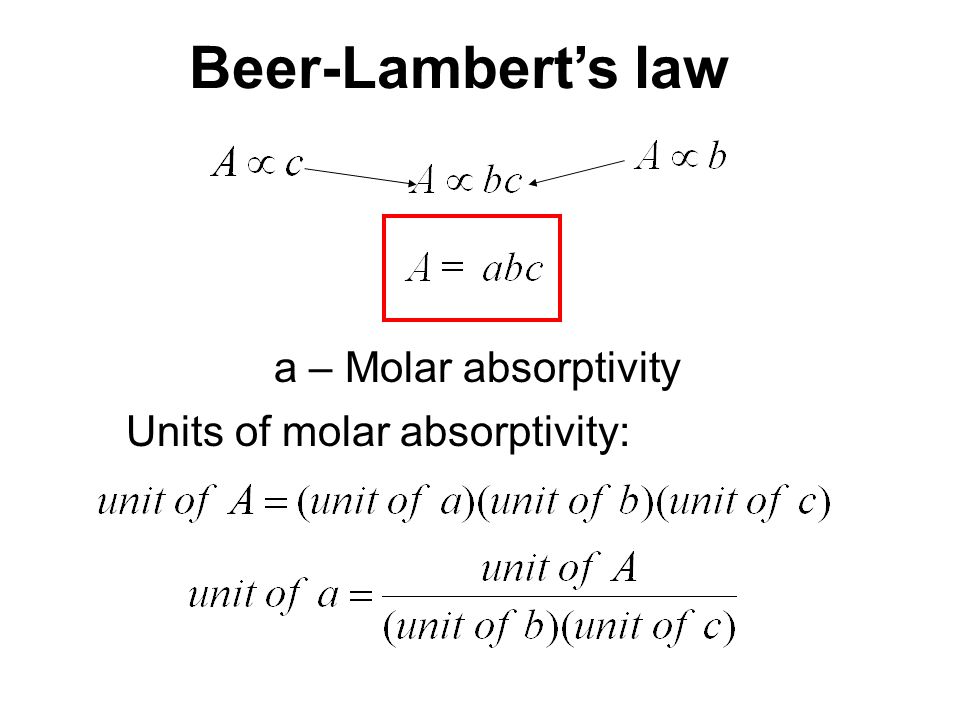
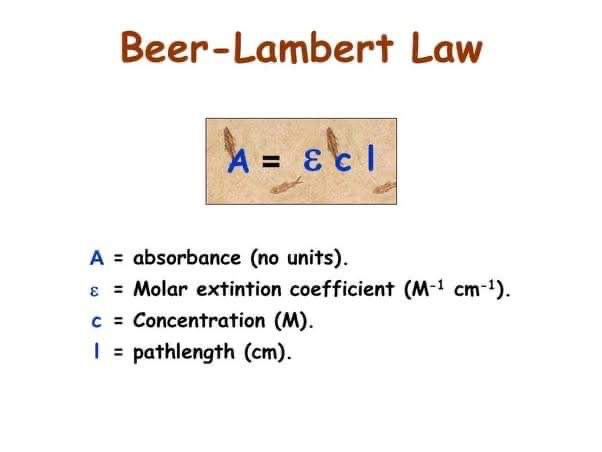
What is unit for absorbance. According to Beers law A εbc where A is the absorbance ε is the molar extinction coefficient b is the path length of the cuvette and c is the concentration. Understand the Beer-Lambert law for absorbance A ɛlc.
The ideal would ve use Reflectance or at least KUBELKA MUNK which is an absorbace corrected by the thichness of beampath because in DRIFT mode the normal Absorbance law de Beer has no. The equation for Beers law is. 40 in commercial products we use a relationship called the Beer-Lambert Law or simply Beers Law.
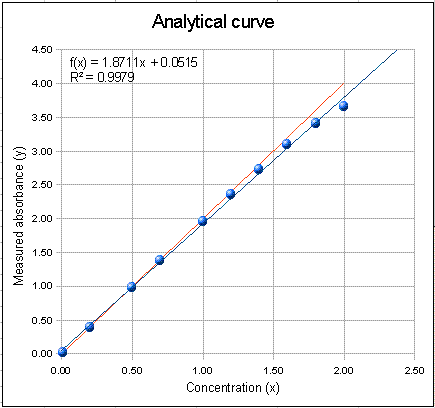
Figure 4 is Beers Law curve for the absorbance of an iron-salicylate complex the substance prepared in todays experiment plotted against different concentrations. Where A is the test absorbance of test. A log10 I o I t a s b.
Absorbance has no unit because when the light passes through a material none of the light is absorbed by the material therefore the absorbance of the material is zero. Absorbance is measured using a spectrophotometer. A εmCl The basic idea here is to use a graph plotting Absorbance vs.
According to Beers Law the absorbance is formulated as. The diagram below shows a beam of monochromatic radiation of radiant power P 0 directed at a sample solutionAbsorption takes place and the beam of radiation leaving the sample has radiant power P. B is the length thickness of the solution.
Each of these can be normalized for molar concentration of the sample. Since there is no absorbance of the light the transmission from the material is 100. The fundamental law regarding the amount of incoming light absorbed by a sample is known as Beers Law.
You will use Beers law. The term is used in many technical areas to quantify the results of an experimental. Lambert beers law that underlies absorbance measurements has the following assumptions.
Thus the molar extinction coefficient can be obtained by calculating the slope of the absorbance vs. A s is the standard absorbance. This is how we will use Beer Lambert law to determine the absorbance of any number of samples.
The important aspect of Beers law in this instance is that Absorbance is linearly related to the concentration of the absorbing species. The standard equation for absorbance is A ɛlc where A is the amount of light absorbed by the sample for a given wavelength ɛ is the molar absorptivity l is the distance that the light travels through the solution and c is the concentration of the absorbing species per unit volume. A graph of absorbance vs concentration is called a Beers Law curve in honor of the chemist who first discovered the relationship between absorbance and concentration.
This article will explain Beer Lambert law most simply. Beer Lambert law consists of the following two laws. According to this law the amount of light absorbed is proportional to the length as well as thickness of the solution taken for analysis.
This value is often reported in milliabsorbance units mA which are a thousandth of an absorbance unit. Absorbance is defined as the logarithm of the ratio of incident to transmitted radiant power through a sample excluding the effects on cell walls. Examine the given Beers law standard curve for an unknown dye measured in a 10 cm cuvette.
This direct relationship is known as Beers Law and is shown by the equation. The standard equation for absorbance is A ɛ x l x c where A is the amount of light absorbed by the sample for a given wavelength ɛ is the molar absorptivity l is the distance that the light travels through the solution and c is the concentration of the absorbing species per unit volume. The true unit of measurement of absorbance is reported as absorbance units or AU.
The Beer Lambert law which is also referred to as Beers Law describes the relationship among absorbance A the molar solute concentration in M c and the length of the path the light takes to get to the sample in centimeters l. So lets get started. What is the concentration in M of a sample of the unknown dye with an absorbance of 025 at 542 nm.
You will be applying Beers law to calculate the concentration. The relation between transmittance T and absorbance A is given by the Beer-Lambert law Beers law. The Beers law plot will be used to determine the concentration of Allura Red in a sample of commercial mouthwash.
Concentration is plotted for the standard solutions a direct relationship should result as shown in Figure 2. Absorbance is directly proportional to concentration and length. A bc where A is absorbance unitless ε is the molar absorptivity M-1 cm c is the light-absorbing analytes concentration M.
When a graph of absorbance vs. A εmCl Aabsorbance εm molar extinction. CD is reported in units of absorbance or ellipticity.
Once you have that you can compare the absorbance value of an unknown sample to figure out its concentration. If the absorptivity for this sample is 15000 Lmolcm what is the molar concentration. Beers Law In 1852 Beer discovered that the transmittance of light decreases exponentially in proportion to the concentration of the species absorbing the light.
Following Beers law the incremental reduction in received power with incremental distance ds caused by attenuation is15dPrds2kLsPrin which kLs is the attenuation coefficient in units of inverse length over an incremental volume along a path centered at range s. This allows the creation of a calibration curve to be constructed between absorbance and known concentrations of the product. The most direct data from the Olis CD instrument is absorbance AbsL- AbsR.
Beer Lambert Law Definition. Many compounds absorb ultraviolet UV or visible Vis light. ε is the wavelength-dependent molar absorbtivity coefficient and it is constant for a particular substance.

Beer Lambert Law Labster Theory
Beer Lambert Law Transmittance Absorbance Edinburgh Instruments
Simulation Of Instrumental Deviation From Beer S Law
Lab 2 Beer S Law And Molar Extinction Coefficients Colorimeter User Manual

Solution Prep And Beer S Law Experiment 1 What Is This Experiment About This Experiment Has 2 Parts To It They Are As Follows 1 How To Make Solutions Ppt Download
Answered Beer Lambert Law A Ecl A Absorbance Bartleby
Beer Lambert Law Transmittance Absorbance Edinburgh Instruments

Beer S Law Uv Vis Spectroscopy Nanodrop The Bumbling Biochemist


